

Tamper Evident
Weber’s Tamper Evident OEM module is specifically designed to fit neatly into existing Serialisation or Pharma Packaging Systems.
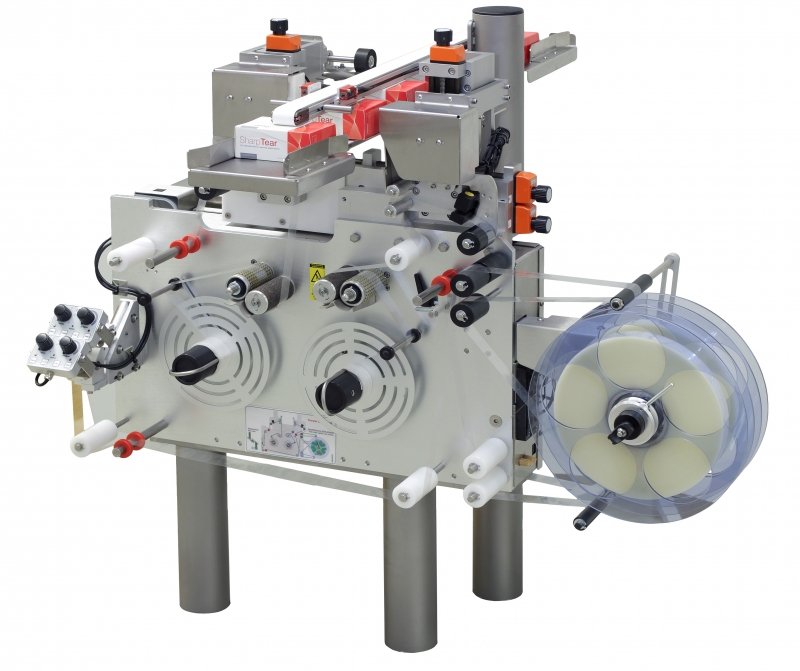
Tamper Evident Labelling Module

The EU Directive 2011/62/EU introduced legal framework requirements for a pan-European safety system for prevention of counterfeit medicines. A central component, which is also addressed in the pharmaceutical law, is a clear and secure marking system for database-backed traceability and tamper-proof sealing of all packaging. Weber can offer a compact, efficient and reliable solution to this requirement. A compact labelling unit is integrated into existing or newly configured Pharma Packaging Systems. A tamper evident label is applied to each end of the carton providing a secure seal which is checked by sensors. The data from all correctly serialized cartons is memorized using the track and trace software allowing each unique pack to be traced back to the manufacturer at any point in the supply chain.
Each individual carton is printed with a unique identity and 2D matrix code produced by sophisitcated track and trace software, which is linked to a vision system. In the event that the vision system detects a mis coded product the system can be configured for use with a Reject Station to dispose of the product.
As this solution is specifically designed for OEM Integration it has a small footprint for ease of installation and configuration. Maintenance and Label Reel change downtime is minimised due to the specific design of the system.
Special Features
- Sealing labelling for protection against counterfeits
- Two-sided corner labelling of folding boxes
- Highly compact design to allow integration into existing plant
- Output clocking up to 300 items per minute
- Stepper motor driven applicator
- Short set-up times when switching to other product formats
- Processing of transparent, perforated labels
- Speed-independent labelling via Tamp-Wipe-On method
- Dual label roll unwinding
Adobe Reader is required to open and view PDF files. This can be downloaded free from adobe.com.
Available Documents
Manufacturing- FEATURES
- Chemical – Drum Labels
- Fast Print Speed of up to 125 mm/sec
- Automatic Label Loading via Label Edge Sensor
- High Quality Printing up to 305 dpi
- Extra-wide (267 mm)
- Printing Area for Giant Labels or Multiple Labels per page
SATO MBi Series
For fast, flawless barcode label printing to go, look no further than SATO’s MB2i and MB4i series of printers.
View ProductSato M10e Label Printer
Zebra DS4308-HC HEALTHCARE SCANNER
In the mission-critical world of healthcare, caregivers need to be able to accurately capture virtually any barcode, on any medium, in any condition — with first-time every time predictability. And with the DS4308-HC on your workstations-on-wheels and other carts, they can. The DS4308-HC does it all — 1-D or 2-D, electronic or printed on paper labels, tiny dense codes on the curved surface of a vial, codes printed on reflective surfaces like IV bags, codes under shrink wrap on doses of medication — and even smudged, scratched or poorly printed barcodes. The result? The priceless peace of mind that the right patient received the right medication and the right test results, every time.
View ProductZebra 220Xi4
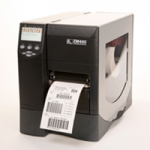
Designed for fast printing of chemical drum and other wide-label applications, count on high-performance when you trust the rugged reliability of this thermal label printer. Standard Features Print methods: Thermal transfer or direct thermal Construction: 12-gauge steel frame Single 32 bit More Standard Features 16 MB SDRAM; 8 MB non-volatile Flash memory Automatic media/ribbon […]
View Product